Interstellar Comet 3I/Atlas: A Rare Astronomical Event
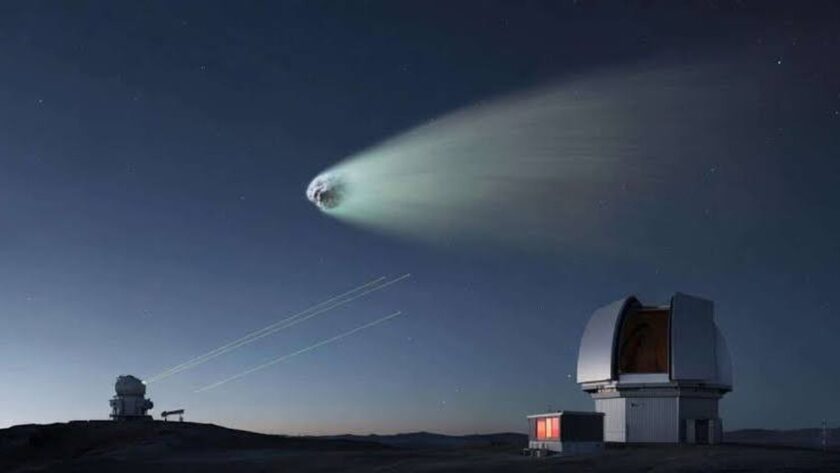
Comet 3I/Atlas, an interstellar visitor estimated to be around 7 billion years old, is currently traversing our solar system. Astronomers worldwide have been fervently tracking its path, and even amateur astronomy enthusiasts are eager to seize the rare opportunity to observe this celestial newcomer through telescopes.
This comet, designated as 3I/Atlas, is the third confirmed interstellar object to have been discovered following ‚Oumuamua in 2017 and 2I/Borisov in 2019. Its name begins with ‚3I‘ to signify its interstellar origin.
Discovered in July 2023, Comet 3I/Atlas entered the solar system in October, passing by Mars at a distance of approximately 30 million kilometers. It will reach its closest point to the Sun on October 30 and is expected to be at its nearest to Earth on December 19, at a distance of about 300 million kilometers. The comet will then leave the solar system in January 2024.
The global astronomical community is seizing the „once-in-a-lifetime“ opportunity to observe this interstellar guest. NASA is utilizing multiple platforms to track the comet from different angles, including three spacecraft currently conducting reconnaissance missions around Mars. Powerful space telescopes, like the James Webb Space Telescope (JWST), will continue to monitor the comet as it approaches Earth. Ground-based observatories also hope to gather more data as the comet nears our planet.
The ATLAS (Asteroid Terrestrial-impact Last Alert System) telescope, funded by NASA and located in Río Hurtado, Chile, was the first to discover 3I/Atlas on July 1. The comet is traveling at an extremely high speed along an unbound hyperbolic trajectory. Measurements from NASA’s Hubble Space Telescope in August indicate that its diameter could be between 440 meters and 5,600 meters, with the comet moving through space at a velocity of approximately 61 kilometers per second upon discovery.
Professor Chris Lintott from the University of Oxford remarked, „This comet was formed in another star system and is likely over 8 billion years old, meaning it predates our solar system. It is the oldest celestial body we have the chance to observe up close.“
Tom Statler, NASA’s chief scientist for small bodies in the solar system, stated, „We are just beginning to understand such objects and exploring the correct questions surrounding them. This opportunity opens a new window for understanding the composition and history of other solar systems.“
Since Comet 3I/Atlas will only be within the solar system for a few months, scientists have a limited time frame for observation. Lintott emphasized, „We only have a few months left before we can no longer see this celestial body, so we aim to collect as much data as possible during this short period.“
By analyzing the chemical composition of Comet 3I/Atlas, scientists may uncover details about the distant star system that birthed it billions of years ago. Early observations have detected significant amounts of carbon dioxide, and it appears to contain nickel, a metal element.
Furthermore, the arrival of Comet 3I/Atlas has sparked conspiracy theories and speculation. Posts and videos on platforms like Reddit, YouTube, and TikTok have claimed that NASA withheld information about the comet during the government shutdown, suggesting that it changed its trajectory or was „deliberately hiding“ behind the Sun, hypothesizing that the comet might be an alien spacecraft.
In July, Harvard University astronomy professor Avi Loeb, who has long studied extraterrestrial objects, co-authored a paper suggesting that 3I/Atlas might be a „potentially hostile“ piece of alien technology. However, this paper, which has not undergone peer review, has been met with controversy.
Loeb pointed to several signs that suggest 3I/Atlas could indeed be a spacecraft from an extraterrestrial civilization. It reportedly made a sudden change in its flight path and displayed a reverse comet tail pointing towards the Sun. Spectral analyses have also detected high concentrations of nickel and minimal amounts of iron, the types of materials that are not commonly found in natural celestial bodies but are prevalent in industrial nickel alloys.
Lintott dismissed the idea that 3I/Atlas could be an alien spaceship, stating, „There is no evidence to support such a claim.“ However, Loeb maintains that we should not rule out the possibility of observing an extraterrestrial vessel.